I ADDED 50 POUNDS TO MY BENCH IN 8 WEEKS WITHOUT CHANGING MY TRAINING
HOW A SLEEP DEPRIVED FIREFIGHTER DISCOVERED THE RECOVERY TOOL THAT BUILDS MORE MSUCLE THAN ANY SUPPLEMENT STACK
Trusted by 10,000+ athletes on TikTok
🛡️30 Day Money-Back Guarantee
⚡️Instant download, 🔐secure Checkout (Stripe)
⚠️ THE RECOVERY MISTAKE COSTING YOU 32% OF YOUR GAINS
If you're training hard but your results don't match your effort, you're making the same mistake I made for 5 years as a firefighter and competitive bodybuilder.
You're obsessing over:
Post workout protein timing
Pre-workout supplements
Training splits and workout routines
Macro counting
While completely ignoring the 8 hour anabolic window that happens every single night
Here's what poor sleep is doing to your progress...
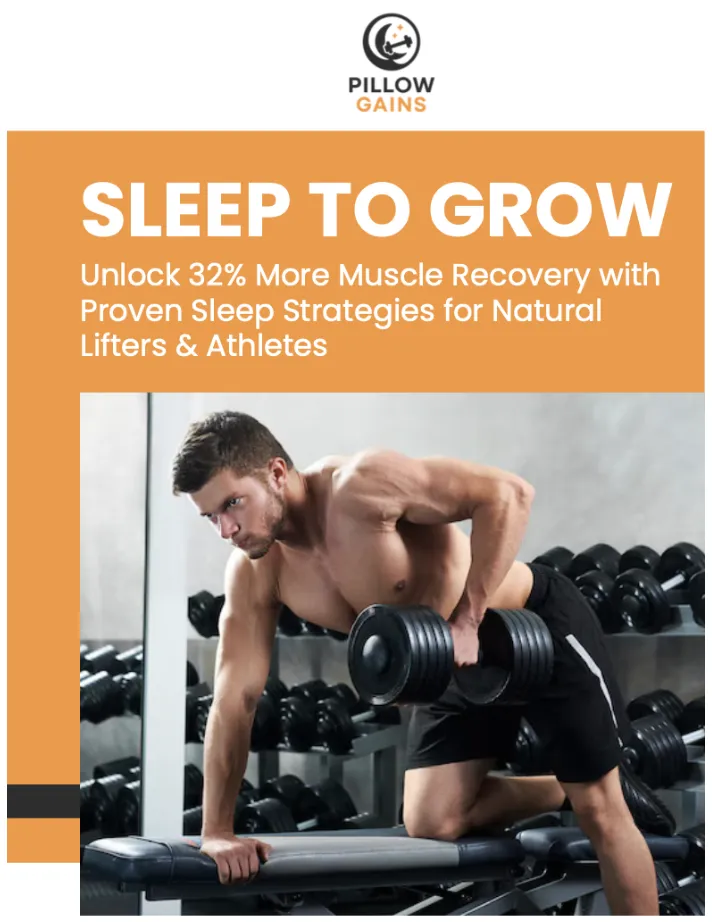
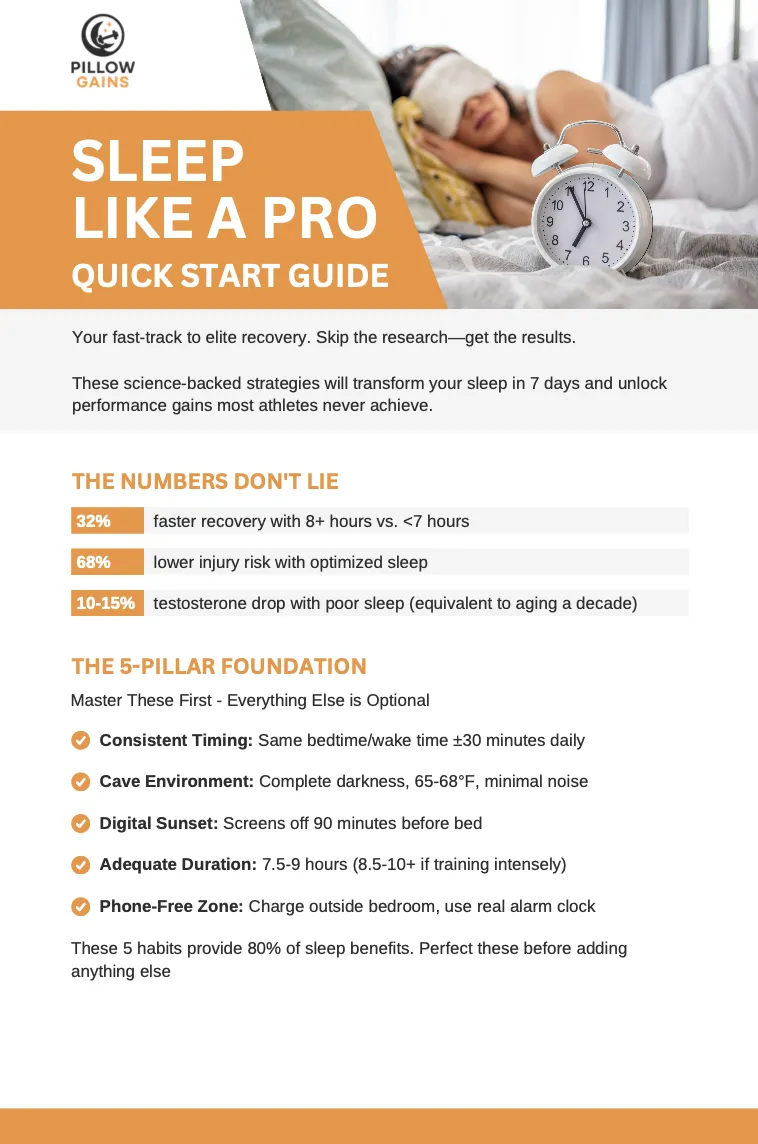
❌ 32% Slower recovery

You're losing nearly a third of your potential gains between sessions
❌ 10 - 15% Testosterone Drop

Equivalent to aging an entire decade - happening in just days of poor sleep
❌ 68% Higher Injury Risk

Your body can't repair itself properly, leaving you vulnerable
I learned this the brutal way, and it nearly destroyed my athletic career
🛑 THE FIVE YEARS THAT NEARLY CRUSHED ME
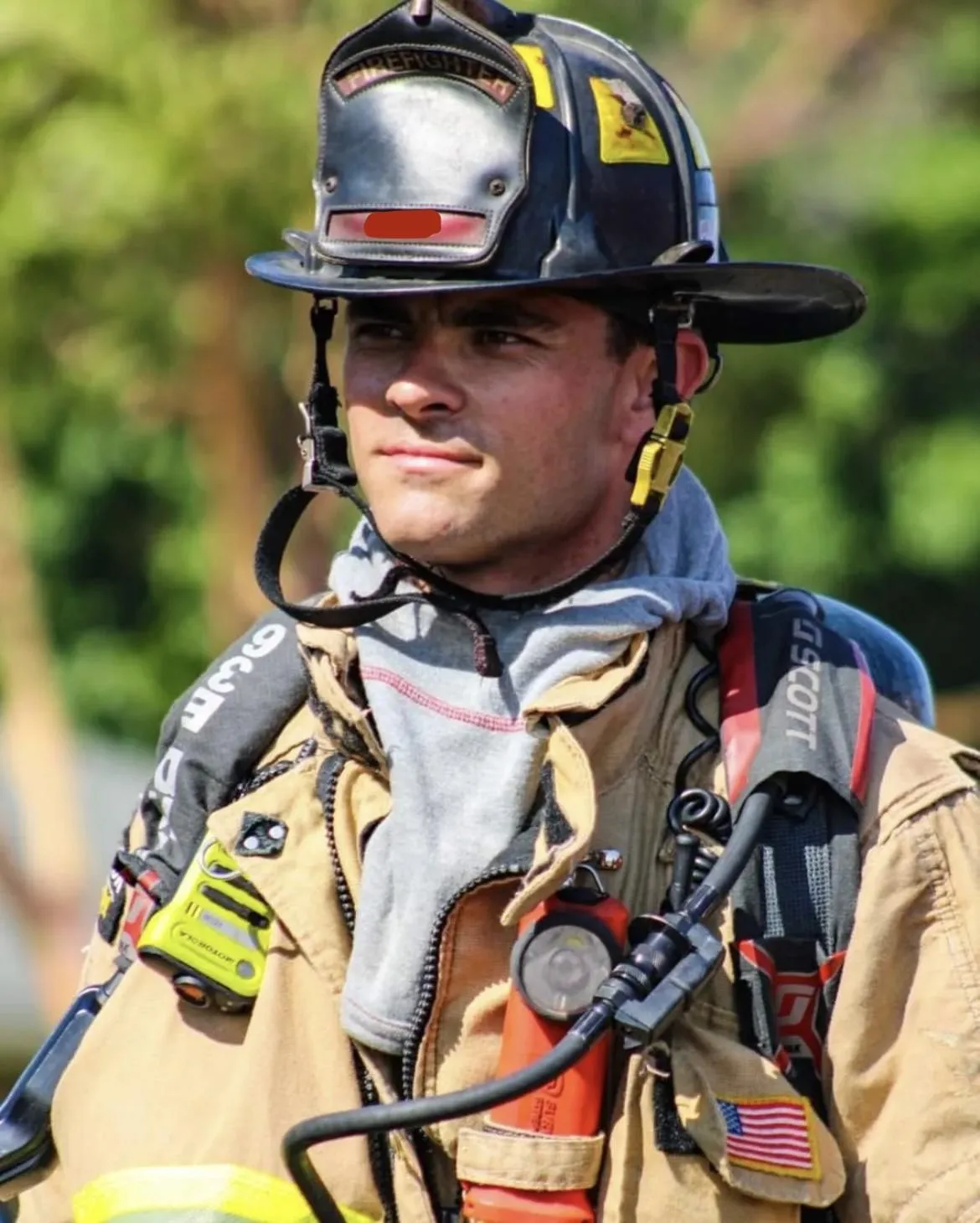
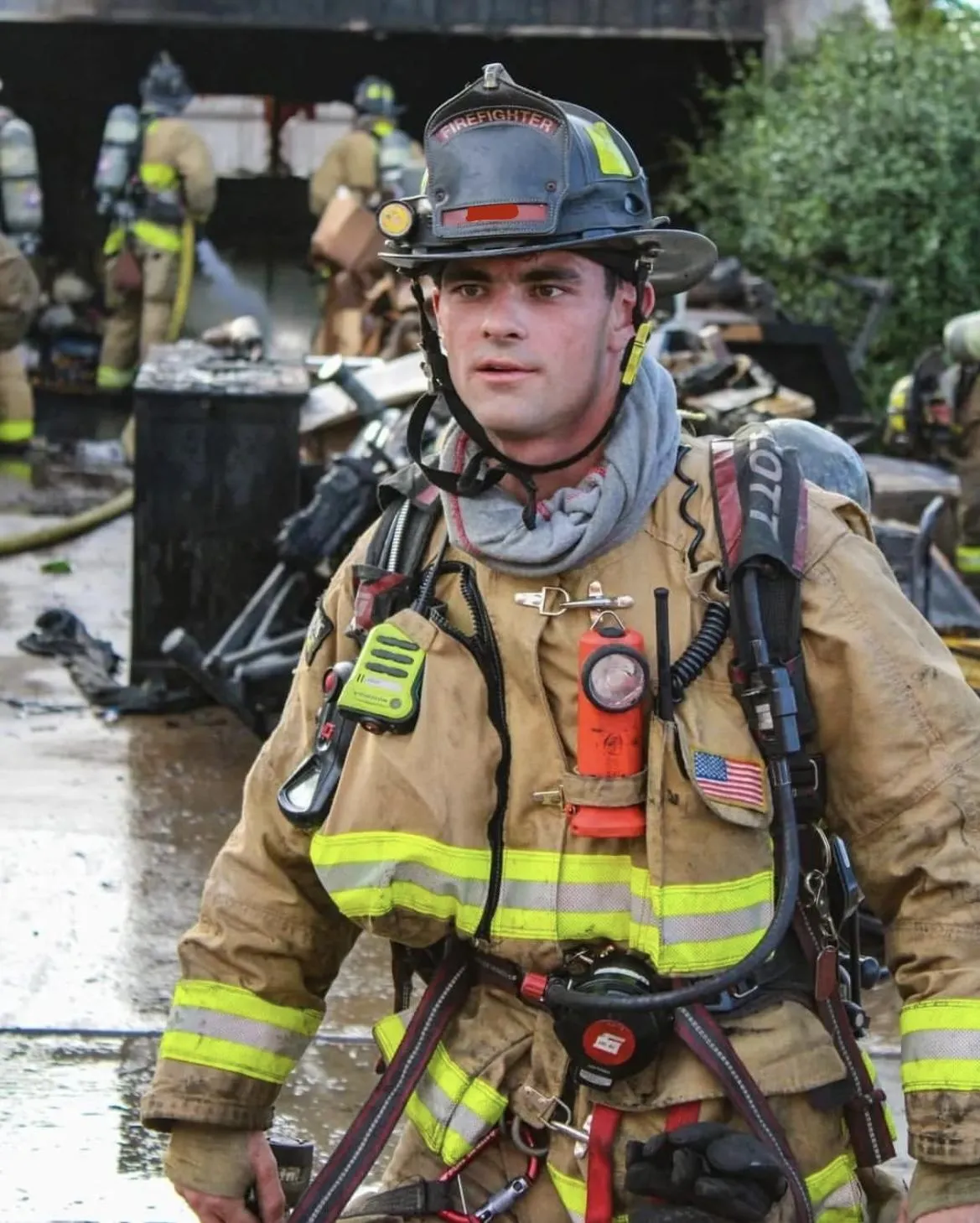
My name is Dustin, and I'm a firefighter and competitive bodybuilder.
For 5 years, I operated on 2-3 hours of sleep per night. Constant interruptions. Irregular schedules. 24-hour shifts that destroyed any consistency.
I watched my performance crumble...
Lifts stalled despite perfect programming
Energy tanked even with stimulants
Recovery took forever
Relationships suffered
My body felt 10 years older
The worst part? I didn't even realize how bad it was until I was deep in the hole.
See, when you're chronically sleep-deprived, you forget what "normal" feels like. You just accept feeling terrible as your new baseline.
Then I fixed my sleep using specific protocols designed for irregular schedules. The results in 8 weeks:
Bench press: 245 → 295 lbs (+50 lbs)
Overall lifts: 15-20% across the board
Energy: Crushing higher rep ranges
Recovery: Finally training hard without burnout
Same training. Same nutrition. Just optimized sleep.
That's when I realized: Most athletes have no idea what they're leaving on the table.
You don't need to be a sleep-deprived firefighter to benefit from this. Even small improvements in sleep quality unlock massive performance gains.
But here's the problem: Every sleep guide out there is generic wellness advice.
"Get 8 hours." "Avoid screens." "Keep it cool."
Cool. What about when you train at 9 PM? What about shift work? What about competition anxiety? What about irregular schedules?
Nobody was talking about sleep optimization FOR ATHLETES.
So I spent months researching the science, testing protocols on myself, and compiling everything that actually works into one system.
Not theory. Not generic tips. Athlete-specific protocols that work with your training schedule, not against it.
💪IS THIS GUIDE FOR YOU?
THIS SYSTEM IS SPECIFICALLY BUILT FOR:
Gym Rats
Serious Lifters 🏋🏼♂️ who want to maximize every training session
Bodybuilders ⚡️seeking every natural advantage for muscle growth
Powerlifters 🥇who need optimal CNS recovery between heavy sessions
Busy Athletes 👨🏼✈️Anyone juggling training with work, family, and irregular schedules
Athletes
Team Sport Athletes 🏈Basketball, soccer, football players who need consistent performance and faster recovery
Endurance Athletes🚴🏼♀️ runners, swimmers chasing personal bests
CrossFit Athletes 🤸🏼High-intensity trainers balancing multiple training demands
Combat Athletes🥊 MMA fighters, boxers, wrestlers who need peak CNS recovery
⭐️ WHAT'S INSIDE⭐️
SLEEP TO GROW
A complete 52-page system for athletic sleep optimization. Here's a sneak peek:
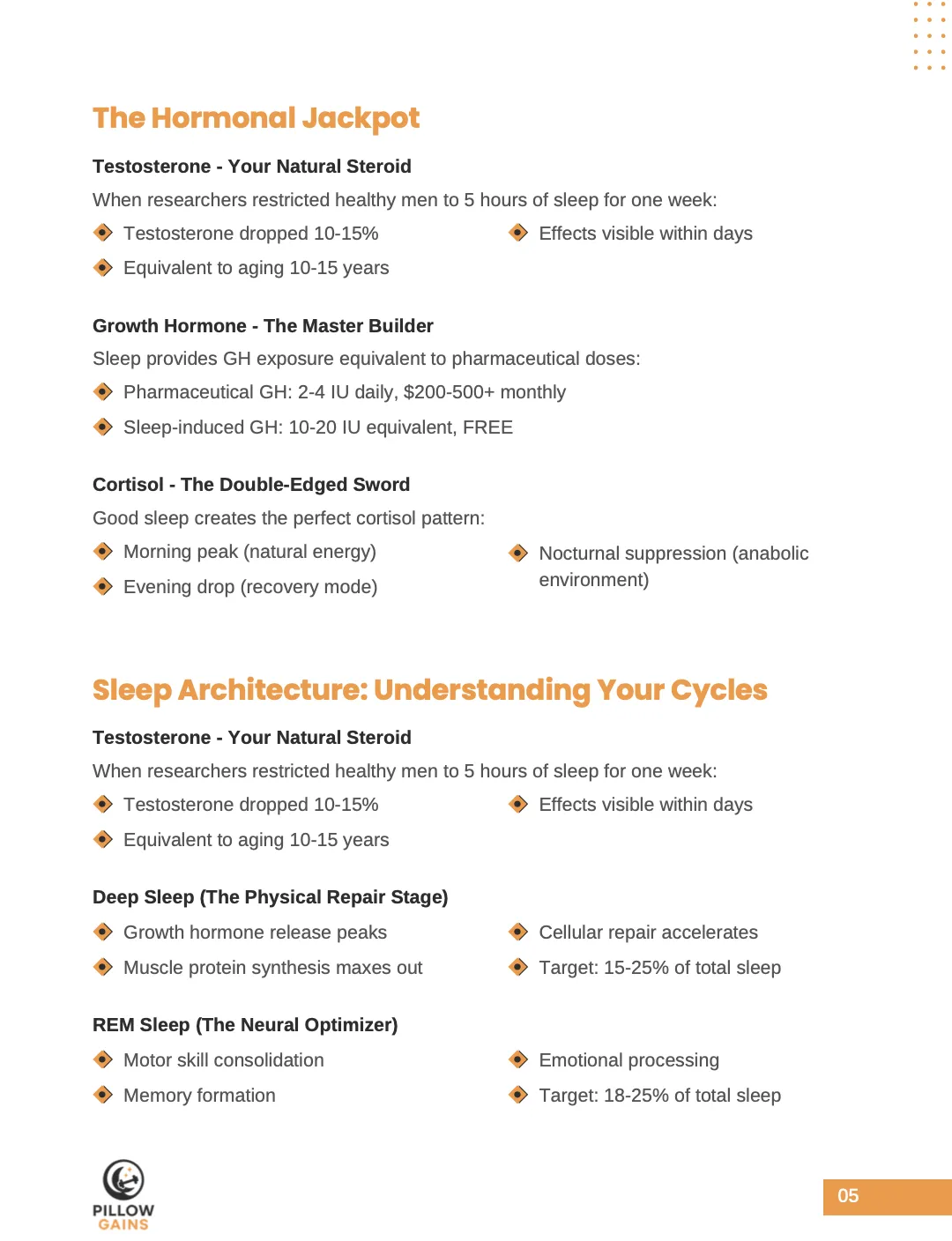
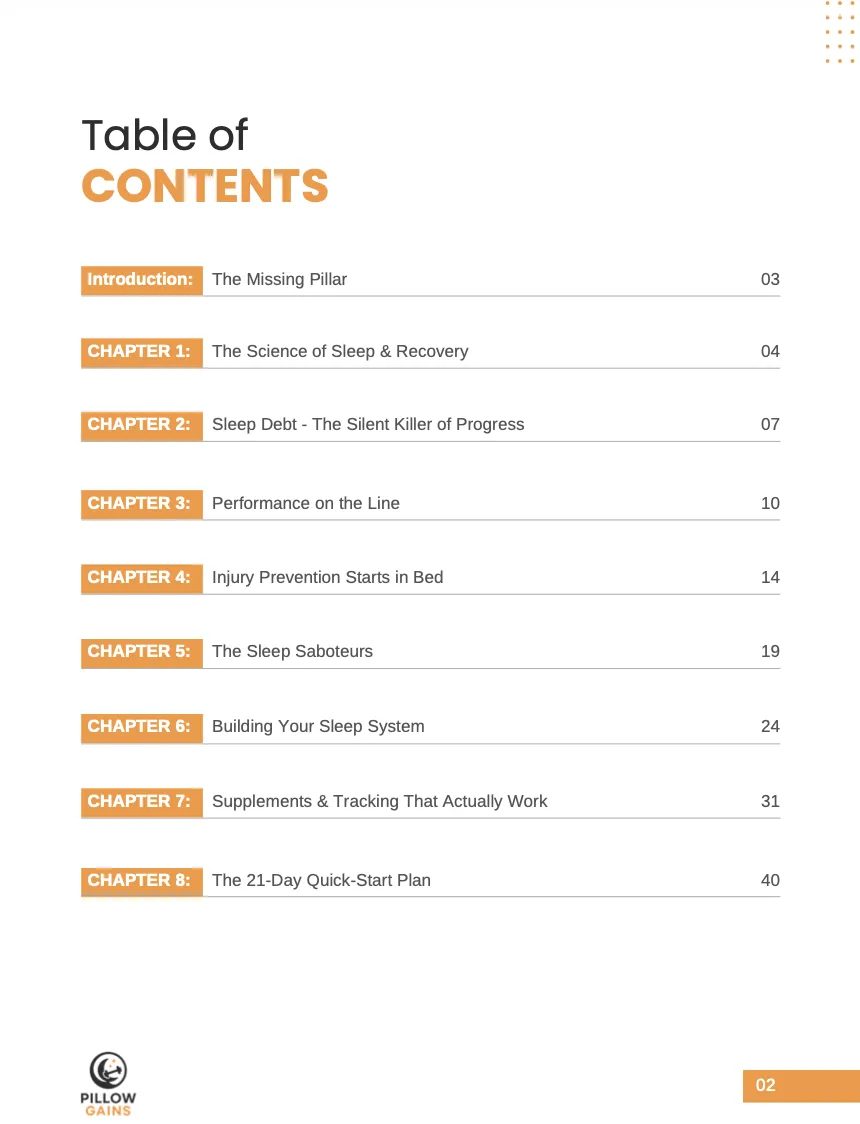
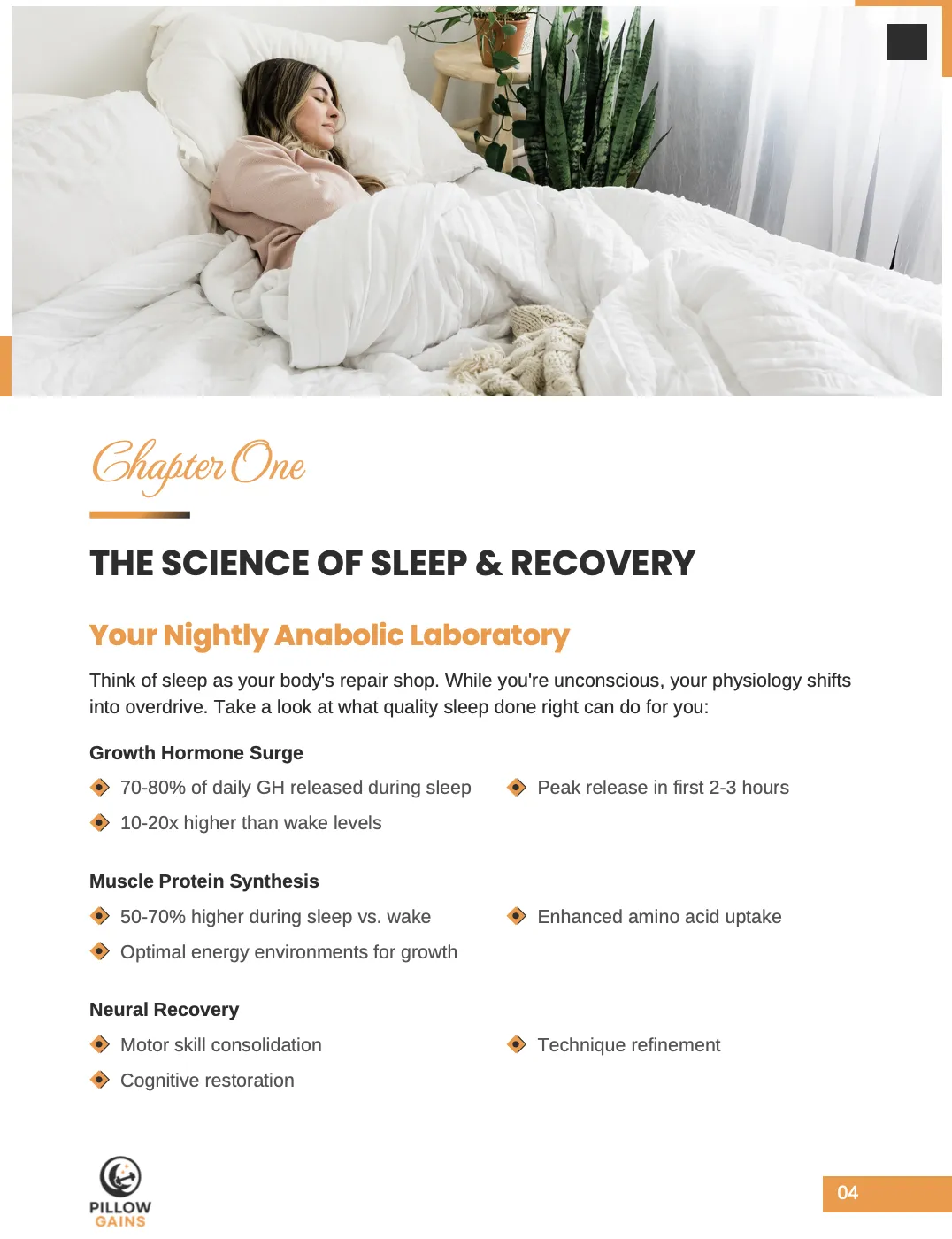
Here's what's covered:
🧪The Science of Sleep and Recovery
How growth hormones surge 70-80% during sleep (and how to take advantage of them)
The extended anabolic window (6-8 hours vs 2-4 post workout)
Sleep architecture: Deep sleep vs. REM and what each does
Testosterone optimization (avoid the 10-15% drop)
⚡️Performance enhancement protocols
Sport specific sleep strategies (strength vs endurance etc.)
Neural recovery for skill acquisition and motor learning
Speed and power optimization through CNS recovery
Competition prep sleep stacks
🛡️Injury prevention System
The 68% solution: How sleep cuts injury risk by more than half
Three layer defense system your body builds during sleep
Inflammation management and tissue repair protocols
Real case studies from Division I and pro teams
💊Supplements that actually work
The only 4 supplements worth your money (ignore the rest)
Exact dosing protocols and timing
Strategic use of supplements
What doesn't work (save your money)
📊Tracking and optimization
HRV monitoring for recovery readiness
Sleep architecture tracking (what actually matters)
Performance correlation protocols
When to reduce training intensity based on sleep data
🚫The Sleep Saboteurs
Caffeine half-life and the cutoff rule
Blue light exposure (suppresses melatonin by 85%)
Late-night training protocols
Nutrition timing disasters to avoid
🏗️Building Your Sleep System
The 90 minute pre-sleep protocol
Environment optimization (temperature, darkness, sound etc.)
Chronotype customization (night owl vs morning lark)
Sport-specific modifications
📆The 21-Day Implementation Plan
Week by week action steps
Habit stacking and automation
Troubleshooting common challenges
Sustainability protocols for long-term success
🔥EVERYTHING INCLUDED IN YOUR PURCHASE
Did someone say bonuses?
✅Sleep to Grow Complete Guide (52 pages) Your systematic, research-backed protocol for transforming sleep into your most powerful recovery tool
Value: $97
✅ BONUS Quick Start Guide 7-Day fast track implementation for immediate results. Skip the research, get the gains Value: $27
✅ BONUS 30-Day Sleep Tracker Science backed tracking system to monitor progress and optimize your protocols Value: $17
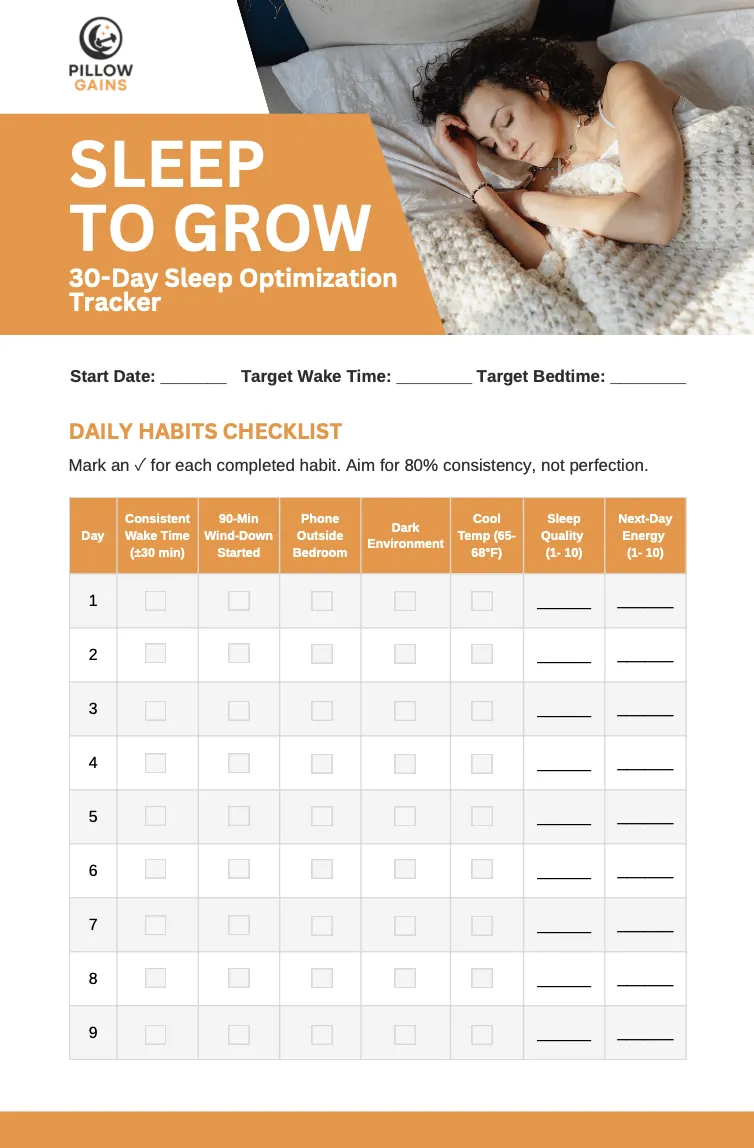
Total Value: $141
Your Investment Today: $19.99
You Save: $121 (85% off)🔥
WHY "SLEEP TO GROW" CRUSHES GENERIC SLEEP ADVICE
Other Sleep Guides
Generic wellness tips
"Get 8 hours" advice
No athletic focus
Theory based
One size fits all approach
Basic sleep hygiene
Ignores training schedules
Sleep to Grow
Sport specific protocols
Irregular schedule solutions
By athletes, for athletes
Real-world tested
Customized by sport type
Performances optimized system
Created by someone who lived it
Works WITH your training
🛡️ZERO RISK 30-DAY GUARANTEE
Try Sleep to Grow for 30 days. Implement the protocols. Track your results.
If you don't see measurable improvements in:
Recovery speed between sessions
Training energy and motivation
Sleep quality and consistency
Overall performance metrics
Simply email us for a full refund. No questions asked. No hoops to jump through.
You either get results you get your money back.
I'm a firefighter who added 50 pounds to my bench in 8 weeks using these exact strategies.
If they don't work for you, I don't deserve your money. Email us for a full refund—no questions asked.
STILL NOT SURE?
QUESTIONS? WE'VE GOT ANSWERS
I don't have time for 8+ hours of sleep with my schedule
A: This guide includes time optimization techniques and sleep efficiency protocols specifically for busy athletes. You'll learn how to get more recovery from less time in bed. Plus, the productivity gains from better sleep often create MORE time in your day. Several protocols are designed specifically for shift workers and irregular schedules.
I've tried improving my sleep before. Will this still work?
A: This isn't generic advice like "avoid blue light" and "keep it cool." This is a systematic, research-backed protocol specifically designed for athletes who train hard. It addresses the unique challenges you face: late training sessions, competition anxiety, irregular schedules, and how to optimize sleep FOR PERFORMANCE, not just rest.
Will this work with my crazy schedule? (Shift work, irregular hours etc.)
A: Yes. This was literally created by a firefighter with one of the most disruptive schedules imaginable. The entire system is built around working WITH irregular schedules, not pretending everyone has a perfect 9-5. You'll get specific protocols for travel, shift work, competition schedules, and late-night training.
Do I need expensive supplements or equipment?"
A: No. The guide covers what supplements actually work (only 4 are worth it, and they're cheap), but the foundation is behavioral and environmental changes that cost nothing. Most athletes see dramatic improvements without spending a dime on supplements.
How long before I see results?
A: Most athletes notice improvements within 7-14 days. Energy and recovery gains come first, followed by performance improvements. The 21-day implementation plan is designed to create sustainable habits that compound over time.
Is this just science and theory? Or practical?
A: It's science-backed but built for implementation. Every chapter ends with actionable protocols. The 21-day plan gives you exact steps for each day. You'll know exactly what to do, when to do it, and how to troubleshoot when life gets in the way.
What if I have a diagnosed sleep disorder?
A: This guide is for optimizing sleep in healthy athletes. If you suspect a sleep disorder (sleep apnea, insomnia, etc.), you should consult a healthcare provider. However, many athletes implement these protocols while working with their doctors and find they complement medical treatment.
Can I share this with my training partners?
A: This is a single-user license for personal use. If your training partners want access, they can grab their own copy at the same price. (Group/team discounts available on request - email us.)
STOP LEAVING 32% OF YOUR GAINS ON THE TABLE
Every night you wait is another night of missed recovery you can't get back.
While others chase marginal gains through expensive supplements and complicated protocols, you can unlock massive improvements through optimized sleep.
Here's what you're getting today:
52 Page sleep to grow system
Quick start guide (7 day fast track)
30 Day sleep tracker
Sport-specific protocols
21-day implementation plan
Supplement guide (what works, what doesn't)
30-day money back guarantee
Investment: $19.99 (less than a meal, more valuable than supplements)
One-time payment. Instant PDF download. Access forever.
🛡️30-Day money back guarantee, ⚡️Instant digital 🔐access, Secure payment (stripe)
⏰ Don't wait another night to optimize your recovery. Every night of poor sleep is 32% of gains you'll never get back.
Sleep optimization for serious athletes. By athletes, for athletes.

Have questions? Email us at [email protected]
(310) 896-6123
© 2025 PillowGains. All rights reserved.